From answer to exploration
Most AI services are still built like a conversation: you ask a question, receive a block of text and follow up. Google is now experimenting with a more spatial way to learn in Gemini.
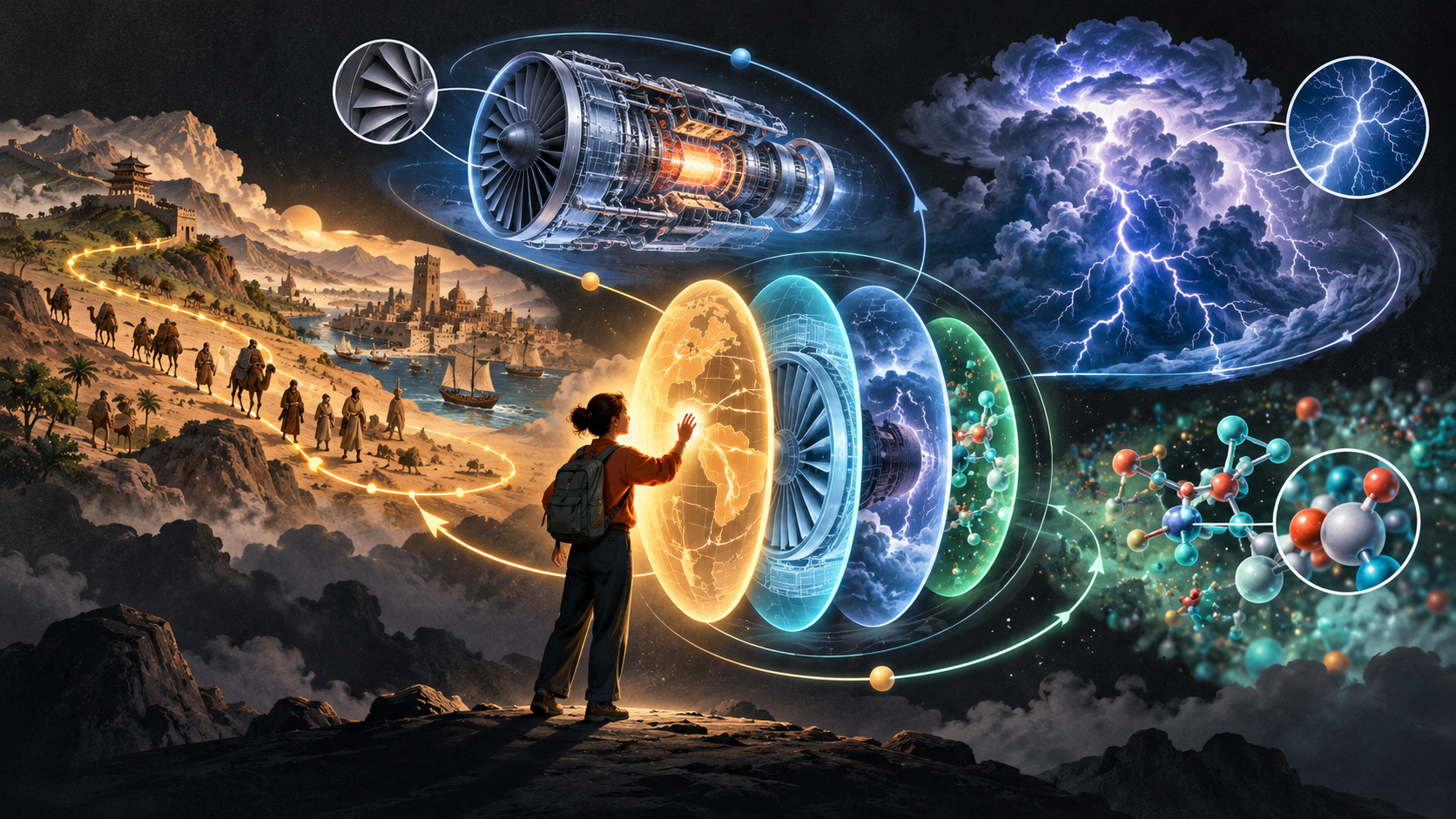
The feature is called Immersive Explorations. It offers interactive visual environments in which a subject can be examined in several layers. The first collection includes examples such as the Silk Road, the workings of a jet engine and the formation of lightning. The idea is to let learners follow connections, change perspective and go deeper wherever curiosity takes hold.
It is a small but interesting shift. AI does not have to stop at writing an explanation; it can also help us find our way through knowledge.
Why the format may help
Continuous prose is excellent when an argument needs to unfold step by step. Some subjects, however, become clearer when we can see both the whole and its details.
A trade route involves geography, time, goods and encounters between cultures. A jet engine makes sense as a flow through several components. A thunderstorm contains processes at very different scales. Separating information into visual layers can make those relationships easier to notice.
That does not mean an interactive image automatically teaches us more. But when it is designed well, it can make it easier to pause, take another route and return to the part that was difficult.
How to try it
Google has placed an initial collection in the Gemini app’s Student Hub. The company says the explorations are available to all users and will soon be launchable directly from a chat as well.
Language support is uneven at this stage. The experiences are available in English, French, Hindi, Indonesian, Brazilian Portuguese and simplified Chinese, among other listed languages. For other languages, including Swedish, they currently appear in English.
A useful way to test the feature is to pick a subject you are already slightly curious about, then write down three things afterwards:
1. What did I see that I had not understood from text?
2. Which part should I verify with another source?
3. Can I explain the connection without looking?
The final question matters. A beautiful visual can feel convincing even when our memory of the explanation itself remains shallow.
AI as a guide — not the final authority
Interactive explorations work best as an entrance to learning, not as the definitive source. Check important facts against textbooks, research or other reliable material. It is also worth asking the AI to show where its information comes from.
The encouraging part is that learning gains more entry points. Someone who does not connect with a long block of prose can begin with a map, mechanism or timeline — and continue reading with better questions.
If AI can help us become more curious, rather than merely finish faster, the technology has found one of its best possible roles.