
The big shift: from answer to assignment
It is easy to think of AI as a question box: you type something, receive an answer and start again. Codex works better with a different mental model. You give it a bounded part of a job, access to the right environment and a clear way to decide when the work is finished.
OpenAI describes an experiment in which Codex worked for roughly 25 hours to build a design tool. It was explicitly an experiment, not a promise that every long run will succeed. What matters is the working loop: plan, edit, run tools and tests, inspect the result, repair failures and update status before the next pass.
That is the real difference between asking for code and delegating an assignment. Work can continue for longer because the model receives feedback from real results. A failed test becomes new information. A preview that looks wrong becomes a reason to revise. But that feedback still needs clear boundaries.
Start with the outcome — and state what is out of scope
A good assignment does not begin with every click the agent should make. Begin with the state that should be true when the work is complete. “Make the home page feel more alive while preserving readability, mobile support and the existing visual language” gives more direction than “add a few boxes”.
Then say what Codex must not do. This can matter as much as the goal: do not change authentication, do not touch payments, do not publish before checks pass, or use only the files that belong to this part of the project.
OpenAI highlights four kinds of durable material in its long-running experiment: a specification containing goals and constraints, a milestone plan, instructions for how the work should be carried out, and a running record of status, decisions and known issues. You do not need four documents for an everyday task, but the mental model is useful in an ordinary chat too.
Four parts that make delegation safer
1. Outcome: Describe the result, the intended reader or user, and what should improve.
2. Boundaries: Say what may change, what must remain intact and which actions require your approval.
3. Checkpoint: Ask for a plan or preview before a risky step. For longer work, define milestones where Codex should test, summarise and continue only when the result holds up.
4. Review: Decide how “done” will be verified. That might mean tests, a working mobile view, comparison with primary sources or your own approval before public release.
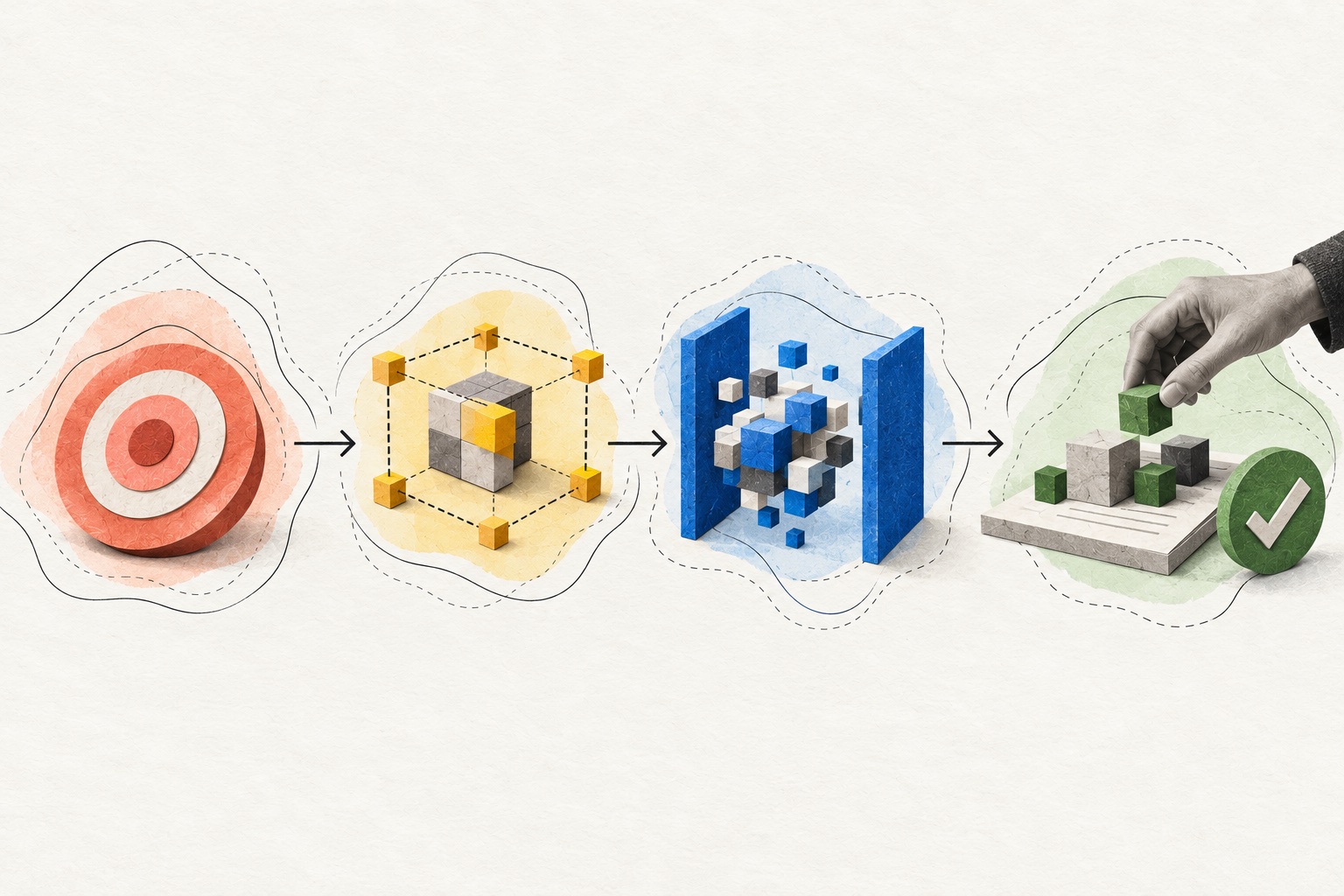
The illustration shows the same flow without jargon: outcome first, boundaries second, a checkpoint third and human review last. The AI has room to work between stations, but it does not receive an undefined blank cheque.
Where can this help in everyday work?
Codex is designed for code and digital projects, but you do not need to be a programmer to benefit. You might ask it to investigate why a website behaves differently on a phone, make a bounded design improvement, check broken links, summarise what changed or create a recurring health check for a site.
It is particularly effective when the task has a visible, testable result. “Make sure all five forms work and report the tests you performed” is better than “improve everything”. “Compare these two versions and propose the smallest safe change” is better than “rebuild the site”.
Recurring work can be automated, but begin manually. Run the task several times, observe the exceptions and add those lessons to the instructions. Automate only when you know what a good result looks like and what should happen when something goes wrong.
Plan before risk — and steer while work is underway
For a larger or more sensitive change, Plan mode is useful: Codex proposes the route before it starts making changes. OpenAI also distinguishes between queuing a follow-up and steering active work. Queue is appropriate when your new request can wait. Steer is appropriate when the work is moving in the wrong direction and needs correction now.
The practical rule is simple: do not interrupt useful work for every new thought. Queue the next idea. But if an important boundary is about to be crossed — the wrong folder, an oversized refactor or the wrong account — steer immediately.
Permissions belong to the same model. Do not grant broader access than the assignment requires. A one-time approval makes sense for something unfamiliar or sensitive. A narrow reusable approval may suit a well-understood step in a trusted project. Feature availability can vary by subscription, app version and connected environment.
A reusable assignment template
Delegate the work — not the judgement
A long run is not valuable because the AI stayed busy for a long time. It is valuable when it produces a reviewable result inside the right boundaries. The best human role is therefore not to watch every keystroke, but to define the outcome, make decisions at checkpoints and judge the finished result.
Codex can absorb much of the implementation and repetitive verification. You retain responsibility for direction, risk and publication. It is less like letting go of the wheel — and more like choosing the route, adding guardrails and letting a persistent collaborator drive one well-defined stretch.